The AI Occupational Exposure (AIOE) measure, developed by Ed Felten (Princeton), Manav Raj (Wharton), and Robert Seamans (NYU Stern), estimates how much each occupation is exposed to advances in artificial intelligence. Rather than predicting which jobs AI will eliminate, AIOE captures how closely the abilities an occupation relies on overlap with the things AI is or will be able to do. The measure and its extensions to industries and geographies are freely available and have been used widely by researchers, policymakers, and journalists.
How the measure works
AIOE links progress in ten common AI applications (such as image recognition, language modeling, reading comprehension, and speech recognition) to the 52 occupational abilities catalogued in the U.S. Department of Labor’s O*NET database. An application-to-ability relatedness matrix was built from a survey of online gig workers who assessed which abilities each AI application could be used for. Each occupation’s exposure is then computed by weighting these ability-level scores by how prevalent and how important each ability is in that occupation. Scores are standardized so that they are easy to compare across occupations.
Origins: the 2018 AEA Papers & Proceedings article
The approach was first introduced in “A Method to Link Advances in Artificial Intelligence to Occupational Abilities” (AEA Papers and Proceedings, May 2018). That paper proposed linking AI advances to specific occupational abilities and aggregating them to the occupation level. It used the method to identify which occupations’ descriptions were most likely to change because of AI progress between 2010 and 2015, and checked those estimates against the Bureau of Labor Statistics’ 2016 update to occupational descriptions.
Full details: the 2021 Strategic Management Journal article
The complete construction of the measure, along with validation exercises and examples of how the data can be used, appears in “Occupational, Industry, and Geographic Exposure to Artificial Intelligence: A Novel Dataset and Its Potential Uses” (Strategic Management Journal, 2021). The article is freely available to download and is the best starting point for anyone who wants to understand or use the data.
The family of measures
- AIOE — AI Occupational Exposure. Exposure to AI for 774 occupations, indexed by six-digit Standard Occupational Classification (SOC) code.
- AIIE — AI Industry Exposure. Exposure by four-digit NAICS industry. Each industry’s score is the employment-weighted average of the AIOE of the occupations that make up its workforce.
- AIGE — AI Geographic Exposure. Exposure for each U.S. county (and state), indexed by FIPS code. Each county’s score weights industry exposure (AIIE) by the industry mix of employment in that county.
- AIOE-LM — Language modeling exposure. Following the release of ChatGPT, the method was re-run counting only the language modeling application, producing occupation and industry exposure to large language models. It was introduced in “How Will Language Modelers like ChatGPT Affect Occupations and Industries?” (2023). Among the most exposed occupations are telemarketers and many postsecondary teachers; among the most exposed industries are legal services and securities, commodities, and investments.
- AIOE-IG — Image generation exposure. The same approach applied to image generation tools such as DALL·E, producing occupation and industry exposure to image generation.
Generative AI exposure and wages
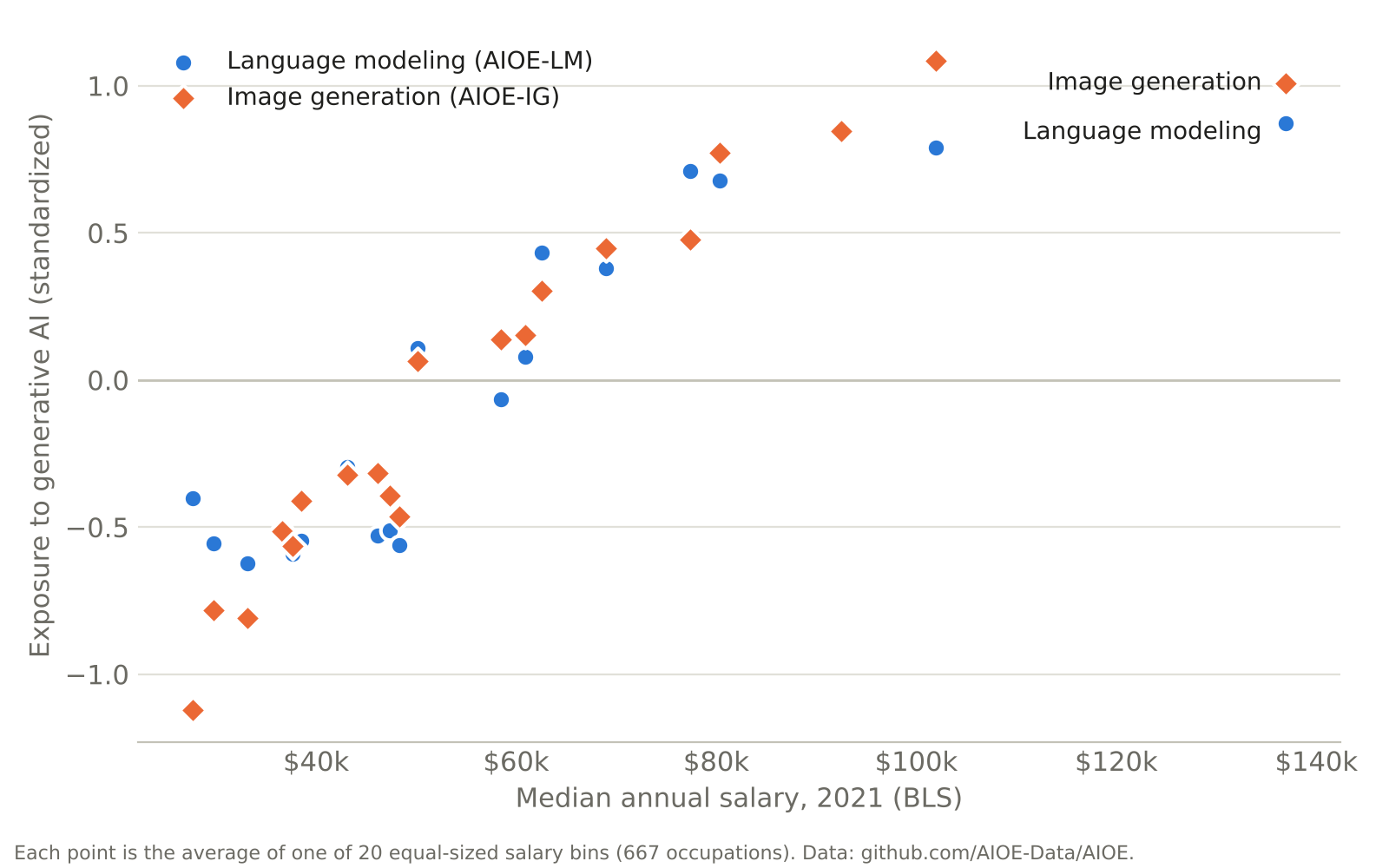
Exposure to generative AI rises with pay. The figure below plots average exposure against median occupational salary, grouping occupations into 20 equal-sized salary bins. Higher-paid occupations are, on average, considerably more exposed to both language modeling and image generation. This pattern, along with similar correlations with required education and creative abilities, is discussed in “Generative AI Requires Broad Labor Policy Considerations” (Communications of the ACM, 2024). That article argues that because it remains unclear when generative AI will substitute for versus complement human work, labor policy should be flexible and broad-based rather than targeted at specific occupations or groups.
Most and least exposed occupations: language modeling (AIOE-LM)
Scores are standardized across all 774 occupations (mean 0, standard deviation 1).
10 most exposed
| Rank | Occupation | AIOE-LM |
|---|---|---|
| 1 | Telemarketers | 1.93 |
| 2 | English Language and Literature Teachers, Postsecondary | 1.86 |
| 3 | Foreign Language and Literature Teachers, Postsecondary | 1.81 |
| 4 | History Teachers, Postsecondary | 1.81 |
| 5 | Law Teachers, Postsecondary | 1.80 |
| 6 | Philosophy and Religion Teachers, Postsecondary | 1.80 |
| 7 | Sociology Teachers, Postsecondary | 1.77 |
| 8 | Political Science Teachers, Postsecondary | 1.77 |
| 9 | Criminal Justice and Law Enforcement Teachers, Postsecondary | 1.75 |
| 10 | Sociologists | 1.75 |
10 least exposed
| Rank | Occupation | AIOE-LM |
|---|---|---|
| 774 | Pressers, Textile, Garment, and Related Materials | −1.85 |
| 773 | Helpers—Brickmasons, Blockmasons, Stonemasons, and Tile and Marble Setters | −1.82 |
| 772 | Dancers | −1.79 |
| 771 | Fallers | −1.79 |
| 770 | Reinforcing Iron and Rebar Workers | −1.78 |
| 769 | Helpers—Painters, Paperhangers, Plasterers, and Stucco Masons | −1.71 |
| 768 | Structural Iron and Steel Workers | −1.70 |
| 767 | Terrazzo Workers and Finishers | −1.68 |
| 766 | Cement Masons and Concrete Finishers | −1.68 |
| 765 | Fence Erectors | −1.68 |
Get the data
All of the measures (AIOE, AIIE, AIGE, AIOE-LM, and AIOE-IG), the underlying application-ability matrix, and the code used to construct them are available in the AIOE-Data GitHub repository.
Notes for users
- Exposure is not displacement. A high score means an occupation’s abilities overlap heavily with what AI is or will be able to do. Whether AI substitutes for or complements workers in that occupation is a separate question that the measure does not answer.
- Scores are relative. Each measure is standardized (mean 0, standard deviation 1), so it is best used to compare occupations, industries, or places with one another. AIOE, AIOE-LM, and AIOE-IG are standardized separately, so their levels should not be compared directly.
- Merging. Occupations are keyed on six-digit SOC codes, industries on four-digit NAICS codes, and geographies on FIPS codes. County FIPS codes are stored as numbers, so leading zeros are dropped (e.g., 1001 is Autauga County, Alabama). Pad them to five digits before merging. The geographic file also includes state-level rows.
- Questions about the data can be sent to Manav Raj (manavraj@wharton.upenn.edu) or Robert Seamans (rseamans@stern.nyu.edu).
How to cite
If you use the AIOE, AIIE, or AIGE data, please cite:
Felten, E., Raj, M., & Seamans, R. (2021). Occupational, industry, and geographic exposure to artificial intelligence: A novel dataset and its potential uses. Strategic Management Journal, 42(12), 2195–2217. https://doi.org/10.1002/smj.3286
If you use the generative AI measures (AIOE-LM or AIOE-IG), please also cite:
Felten, E., Raj, M., & Seamans, R. (2023). How will language modelers like ChatGPT affect occupations and industries? arXiv:2303.01157. https://arxiv.org/abs/2303.01157
Related:
Felten, E. W., Raj, M., & Seamans, R. (2018). A method to link advances in artificial intelligence to occupational abilities. AEA Papers and Proceedings, 108, 54–57. https://doi.org/10.1257/pandp.20181021
Felten, E., Raj, M., & Seamans, R. (2024). Generative AI requires broad labor policy considerations. Communications of the ACM, 67(8), 29–32. https://doi.org/10.1145/3637864
BibTeX:
@article{felten2021occupational, author = {Felten, Edward and Raj, Manav and Seamans, Robert}, title = {Occupational, Industry, and Geographic Exposure to Artificial Intelligence: A Novel Dataset and Its Potential Uses}, journal = {Strategic Management Journal}, volume = {42}, number = {12}, pages = {2195--2217}, year = {2021}, doi = {10.1002/smj.3286}}@misc{felten2023language, author = {Felten, Ed and Raj, Manav and Seamans, Robert}, title = {How Will Language Modelers like {ChatGPT} Affect Occupations and Industries?}, year = {2023}, eprint = {2303.01157}, archivePrefix = {arXiv}, primaryClass = {econ.GN}}@article{felten2018method, author = {Felten, Edward W. and Raj, Manav and Seamans, Robert}, title = {A Method to Link Advances in Artificial Intelligence to Occupational Abilities}, journal = {AEA Papers and Proceedings}, volume = {108}, pages = {54--57}, year = {2018}, doi = {10.1257/pandp.20181021}}@article{felten2024generative, author = {Felten, Ed and Raj, Manav and Seamans, Rob}, title = {Generative {AI} Requires Broad Labor Policy Considerations}, journal = {Communications of the ACM}, volume = {67}, number = {8}, pages = {29--32}, year = {2024}, doi = {10.1145/3637864}}
Last updated: November 2026

